
Keep the Mortgage or Pay It Down? Conditions on Both Sides
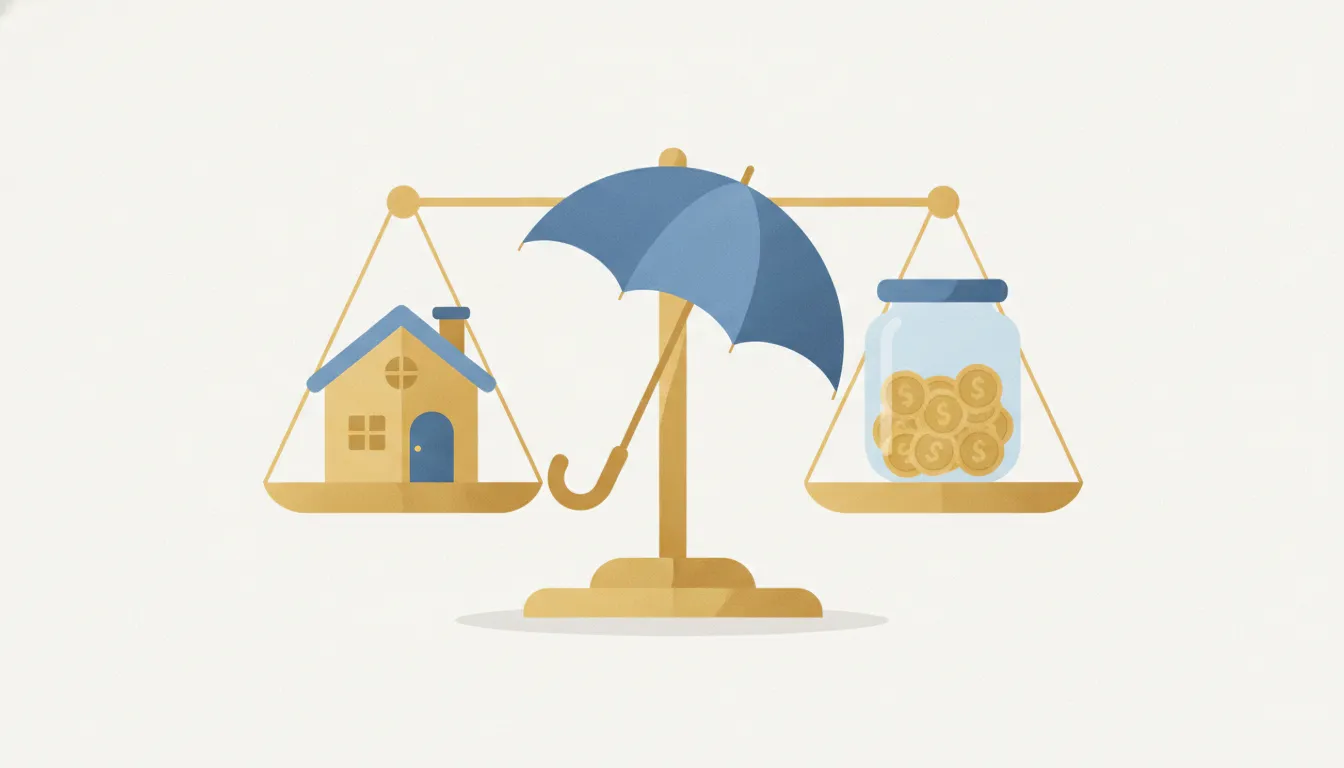
A household with a mortgage and a little extra money each month usually faces the same question: send it to the loan, or keep it somewhere else? Neither answer is right for everyone. Extra payments work like earning the loan's interest rate, but on money that is hard to get back out of the house. The best fit depends on the loan's rate, how much cash a household holds, what other debts it carries, and how it feels about owing money.
Key takeaways
- Extra mortgage payments work much like earning the loan's interest rate on that money, a result known in advance on a fixed-rate loan but tied up in the house.
- In a hypothetical loan at 3.5 percent, an extra $300 a month for ten years lowers the balance by about $43,030, the same result as an account earning 3.5 percent.
- Households that keep a low-rate loan often point to cash reserves, access to money and other debts with higher rates.
- Households that pay down often point to a higher loan rate, a preference for owing nothing, or a goal such as retiring the loan before income falls.
- Checking for a prepayment penalty and confirming extra money goes to principal are practical steps either way.
What an extra payment does in numbers
Consider a hypothetical household with $250,000 left on a mortgage and 25 years to go. At 3.5 percent, the principal and interest payment is about $1,252. After ten years of regular payments, the balance would be about $175,072.
Now suppose the household adds $300 a month. After the same ten years, the balance would be about $132,042, which is $43,030 lower. That is exactly what $300 a month would reach in an account earning a steady 3.5 percent. In other words, the extra payments behave like a return equal to the loan's rate.
The same extra payments on a 7 percent loan would lower the balance by about $51,925 over ten years. Other places for the money would need to beat that to come out ahead:
- An account assumed to earn 4 percent would reach about $44,175.
- An account assumed to earn 6 percent would reach about $49,164.
Those rates are illustrations, not forecasts, and real returns can be higher, lower or negative. The comparison also leaves out taxes, fees, rate changes and the differences described below.
Conditions that lead some households to keep a low-rate loan
People who keep a low-rate mortgage while saving elsewhere tend to point to a few conditions:
- A thin cash cushion. According to the Consumer Financial Protection Bureau, a reserve fund can help households avoid leaning on credit when something unexpected happens. Money sent to principal cannot be spent on a surprise repair.
- Limited access to home equity. A home equity line of credit can be a way to reach equity later, but the CFPB notes a lender might freeze additional borrowing if the home's value drops significantly or financial circumstances change. Access may disappear when it is needed most.
- Higher-rate debts elsewhere. Credit cards and some other debts often carry higher rates than a mortgage, so many households weigh those first.
- Other goals competing for the same dollars. Retirement saving, education costs or a business may all draw on the same monthly surplus.
- Tax effects. The Internal Revenue Service describes qualified mortgage interest as an itemized deduction, so any benefit depends on whether a household itemizes. A tax professional can say how it applies.
Conditions that lead others to pay down
Households that send extra to the mortgage often have different circumstances or priorities:
- A higher loan rate. As the 7 percent example shows, the bigger the rate, the harder it is for other options to compete.
- A preference for owing nothing. Some people dislike debt more than they value a higher return elsewhere. The price of that comfort can be estimated as the gap between the loan's rate and what the money might otherwise earn.
- A target date. Some want the loan retired before retirement or a planned drop in income.
- Mortgage insurance. Private mortgage insurance has balance thresholds for cancellation, and the CFPB explains how they work. A household can ask its servicer how extra principal payments interact with them.
- Forced saving. For those who find idle cash tends to get spent, a regular extra payment can be a discipline that works.
- Household agreement. When partners differ on risk, splitting the surplus is one way some couples avoid recurring disagreement.
Looking at it through safety, liquidity and return
Return is only one lens. Safety asks which choice is less risky, and which one feels less risky, since both matter. Money in the house is secure while the household keeps the home, but an investment value can fall. Liquidity asks how quickly the money can be used. Cash in an account is available within days, while equity in a house is usually reachable only by selling or borrowing.
Practical checks before sending extra
The CFPB explains that a prepayment penalty typically applies only if the entire balance is paid off within a set period, often three or five years, and that small extra principal payments do not normally trigger one. It also notes that a large lump sum might. Reading the loan documents, or asking the servicer, settles the question.
It is also worth confirming that extra money is applied to principal rather than held toward a future payment.
Questions to ask
- What is the rate on this loan, and what would the same money earn or save in other uses after taxes?
- How many months of expenses would remain in cash after the extra payment?
- Do any higher-rate debts remain?
- How would the household reach money tied up in the house if it were needed?
- What is the value of having no payment, and what does it cost?
- Does the loan have a prepayment penalty or other terms that matter?
Answering these does not produce one correct choice. It lets a household see what it is trading and decide knowingly.
Common questions
Is paying extra on my mortgage the same as earning a return?
In arithmetic terms, extra principal payments save interest at the loan's rate, so they resemble a return equal to that rate. The comparison leaves out taxes, risk, and the fact that money paid into the house is hard to get back.
Can a mortgage have a penalty for paying extra?
The Consumer Financial Protection Bureau says a prepayment penalty typically applies only when the entire balance is paid off within a set period, and that small extra principal payments do not normally trigger one. Confirming with the lender is always wise.
Why would someone pay off a low-rate mortgage anyway?
Some households value having no required housing payment, want to lower fixed expenses before retiring, or find that extra payments are the only way the money gets set aside. The numbers can show the price of that comfort so the choice is deliberate.
Explore your next step
Sources and further reading
From the Borrow Smart newsletter
NIFE provides general financial education. LendsightAI and Debt Done Date are separate for-profit partners; optional services may have a fee.