
Extra Mortgage Payments or Flexible Cash? Weighing the Trade-Off
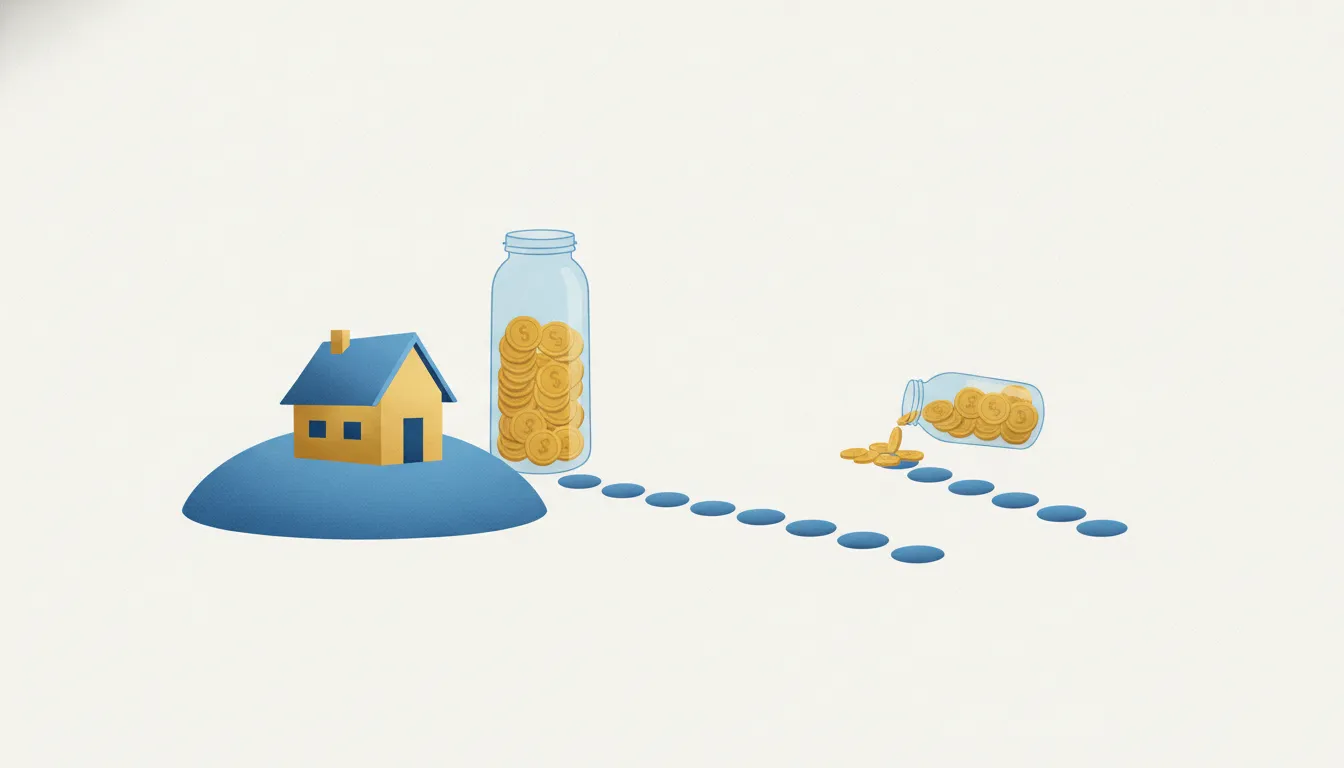
A household finds it has an extra few hundred dollars each month. One option is to send it to the mortgage. Another is to keep it flexible, whether in savings, in investments or as a buffer. Which fits better? The answer turns on three things: the interest rate on the loan, what the alternative could realistically earn after accounting for risk, and how much access to cash the household wants to keep.
Key takeaways
- Extra payments on a fixed-rate mortgage avoid interest at that loan's rate, while the alternative uses of the same cash come with uncertain results.
- In the hypothetical example, an extra $300 a month on a $250,000 loan at 4 percent ends the loan about seven years sooner and avoids roughly $44,000 of interest.
- In the same example, the extra payments and a savings account earning about the mortgage rate end up in roughly the same place after 25 years.
- Money paid into a mortgage is hard to get back without selling or borrowing, so households often weigh access to cash alongside interest saved.
- Longer loan terms give a lower required payment with the option to pay extra, though the rate on a shorter loan can be lower, so quotes are worth comparing.
Two uses for the same cash
Extra principal payments reduce the balance, and a lower balance means less interest charged from then on. On a fixed-rate loan, that saving is predictable, because it works at the loan's rate.
Keeping the cash flexible has its own value. It can cover a repair or a gap in income, or it can be saved or invested toward other goals. The outcome is less certain, since savings rates move and investment returns vary.
A worked example
Consider a hypothetical household with $250,000 left on a fixed 4 percent mortgage with 25 years to go. The payment of principal and interest is about $1,320. It has $300 a month to spare.
If the household adds $300 to the mortgage each month, the loan is repaid in about 18 years and 2 months, roughly seven years early. Total interest drops from about $145,900 to about $101,700, a difference of about $44,200.
Now compare the endpoints. In one path, the household pays the regular amount and puts $300 a month into an account for 25 years. In the other, it pays the extra amount until the loan is gone, then sends the whole former payment, about $1,620, to the same account for the remaining years. Here is what the account holds at the end under three assumed, steady rates of return:
- At 2 percent: about $116,600 in the first path versus about $142,200 in the second.
- At 4 percent: about $154,200 versus about $152,400, nearly the same.
- At 6 percent: about $207,900 versus about $163,700.
When the account earns less than the mortgage costs, the extra payments come out ahead. Near the mortgage rate, the paths are close. Above it, the account pulls ahead. These are steady rates held for 25 years, which real markets do not provide. They also leave out taxes, fees and withdrawal rules.
What the example hides
The 6 percent line looks good, but it is an assumption and not a forecast. The U.S. Securities and Exchange Commission's investor education site says that the greater the potential return, the greater the risk, and that no mutual fund can guarantee its returns. Investments can fall in value, sometimes for years, which is a risk the mortgage paydown path does not share. A household that must sell investments in a down year to cover a bill could end up well behind the steady-rate example above.
Some households also factor in temperament. A paid-down loan gives certainty, which has value on its own, while a flexible cushion gives options. Neither is a wrong instinct.
The price of access to cash
Money paid into a mortgage reduces the balance, and the home does not hand it back. After five years of $300 extra payments in the example, the household has put in $18,000 and the balance is about $19,900 lower than it would have been, roughly $197,900 compared with $217,800. Getting that money back would generally mean selling or borrowing against the home, with the costs, approval and interest that go with it.
This is why many households ask a few things first. Is there a cash cushion for surprises? Do other debts carry higher rates than the mortgage? Is the income steady? The answers can change which use of spare cash makes sense.
Term length and flexibility
The same logic shows up when choosing a loan term. A shorter term, such as 15 years, requires a higher payment every month, whatever happens. A 30-year term has a lower required payment, and the household can still add extra whenever it chooses. That flexibility has a price, because rates on shorter loans can be lower, so comparing quotes for each term shows what is being given up.
Before relying on extra payments, check the loan terms. The Consumer Financial Protection Bureau explains that a prepayment penalty is a fee some lenders charge if you pay off all or part of your mortgage early. It typically applies only when the whole balance is paid off, such as in a sale or refinance within a set period, and it does not normally apply to small extra principal payments. Confirming with the lender is a good step either way.
Questions to ask
- What is my loan's rate, and is it fixed or adjustable?
- What could the alternative realistically earn, and what could it lose?
- How many months of expenses are in my cash cushion?
- Do I carry any debt with a higher rate than my mortgage?
- Does my loan have a prepayment penalty, and how are extra payments applied?
- How would I feel if the invested money fell in value when I needed it?
Common questions
Is it better to pay extra on my mortgage or invest the money?
It depends on the mortgage rate, what the alternative could realistically earn after risk, and how much access to cash a household wants. Extra payments save interest at the loan's rate, while other uses may earn more or less, and can lose money.
Can I be penalized for making extra mortgage payments?
The Consumer Financial Protection Bureau says a prepayment penalty typically applies only when the entire balance is paid off, such as in a sale or refinance, and not to small extra principal payments. It advises checking your own loan documents and lender.
Can I get extra mortgage payments back if I need the money?
Not directly. The money reduces what you owe. To reach it again, a household would generally need to borrow against the home or sell it, which can involve costs and approval.
Explore your next step
Sources and further reading
From the Borrow Smart newsletter
NIFE provides general financial education. LendsightAI and Debt Done Date are separate for-profit partners; optional services may have a fee.