
Extra Debt Payments vs. a Cash Reserve: The Homeowner's Trade-Off
Key takeaways
- An extra debt payment permanently reduces your loan balance, but it also converts liquid cash into home equity that cannot be accessed quickly without borrowing again.
- Home repairs are both unpredictable in timing and often non-negotiable in urgency, making accessible cash a functional necessity for homeowners rather than a luxury.
- Financing an emergency repair at a high interest rate can cost more over time than the interest saved by applying that same cash to a lower-rate loan earlier.
- Treating debt paydown and cash reserves as parallel goals — rather than competing ones — allows a household to make steady progress on both.
- The right balance between extra payments and a cash cushion shifts as a home ages, debts change, and household income evolves, so it is worth revisiting periodically.
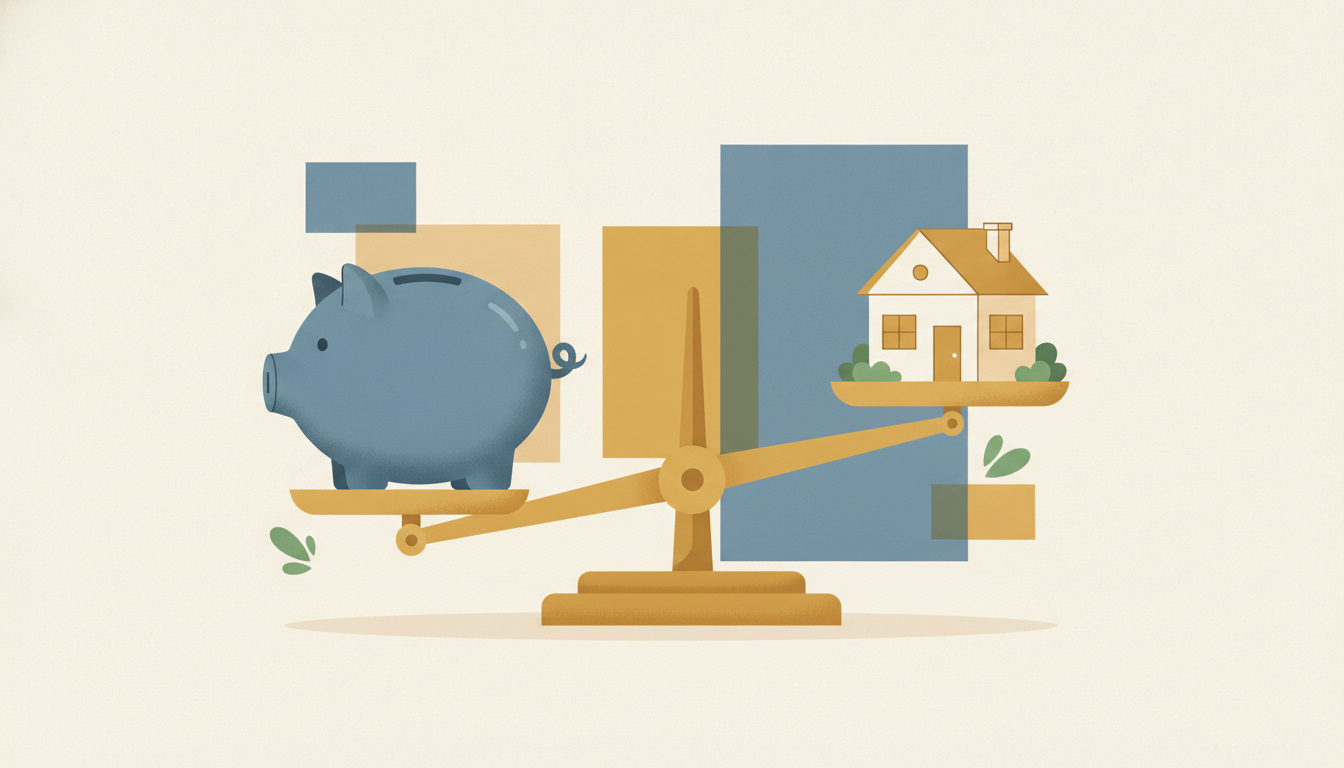
Owning a home changes the stakes of a question that renters rarely face quite as sharply: when extra money comes in, is it smarter to put it toward debt or to keep it accessible as cash? Both choices have real value, and the tension between them is one of the most practical financial puzzles a homeowner encounters.
Why the Trade-Off Exists
Every dollar used to pay down a loan does something useful: it reduces the balance that interest is charged on. If a household carries a loan with a meaningful interest rate, an extra payment today can save a noticeable amount over the remaining life of the loan. The math is straightforward — lower balance, less interest, faster payoff. For a deeper look at how rates shape that arithmetic, see Interest Is the Price of Time: How Rates Shape Your Goals.
But that same dollar, once applied to a mortgage or other debt, is no longer liquid. It has been converted into home equity or reduced loan balance — forms of value that cannot be tapped quickly without refinancing, taking out a new loan, or selling the property. For a homeowner, that inflexibility carries a specific cost.
The Homeowner's Repair Reality
A home is a physical asset that breaks down. Roofs age. Water heaters fail. HVAC systems quit, often in the middle of summer or winter. Unlike a renter who calls a landlord, a homeowner is the landlord — and the repair bill lands directly in their lap.
These expenses share two uncomfortable traits: they are unpredictable in timing, and they are often non-negotiable in urgency. A failing roof or burst pipe cannot be deferred the way a discretionary purchase can. When a household doesn't have cash set aside, covering an urgent repair typically means putting it on a credit card, taking out a personal loan, or scrambling to find another source of funds — each of which can carry its own cost and stress.
The Consumer Financial Protection Bureau describes an emergency fund as "a cash reserve that's specifically set aside for unplanned expenses or financial emergencies," listing home repairs explicitly among the most common examples. It also notes that without accessible savings, "a financial shock — even minor — could set you back, and if it turns into debt, it can potentially have a lasting impact."
That framing captures the core risk: an unexpected repair that gets financed at a high interest rate can easily cost more over time than the interest saved by applying that cash to a lower-rate mortgage earlier. Understanding how the gap between savings-rate debt and other debt costs is part of thinking this through clearly.
Thinking About the Trade-Off in Layers
One way to approach this is to think about the interest rates involved and the liquidity of each option — not as a formula, but as a framework for asking the right questions.
Rate on the debt. The higher the interest rate on a loan, the more valuable each extra dollar applied to it becomes. A high-rate debt costs more every month it carries a balance. Households with multiple debts at different rates may find it helpful to map out the full picture — something Your Blended Rate: What All Your Debts Cost Together walks through — before deciding where extra dollars go.
Likelihood and cost of near-term repairs. An older home with aging systems presents a different picture than a newer home still under builder warranties. A household that recently replaced the roof and HVAC may carry less near-term repair risk than one with equipment that is well past its typical lifespan.
How accessible the cash would be in an emergency. A savings account at a bank or credit union is immediately available. Home equity, by contrast, requires a loan process to access — time and effort that may not be available when a repair is urgent. The CFPB notes that emergency savings should be "safe, accessible, and in a place where you're not tempted to spend it on non-emergencies."
What happens if the emergency fund runs dry. If the household would turn to credit cards or high-rate borrowing to cover a sudden repair, the cost of being underprepared becomes concrete. For illustrative purposes: a household that finances a $5,000 repair on a credit card at a high rate and carries the balance for two years could pay several hundred dollars in interest — potentially more than the interest savings from having applied that $5,000 to a lower-rate mortgage over the same period.
A Parallel, Not a Binary
It may help to think of these two goals — reducing debt and maintaining a cash cushion — as running in parallel rather than competing in a zero-sum way. Some households choose to direct a fixed portion of surplus cash toward debt paydown each month while consistently routing another portion to a dedicated reserve account.
The CFPB describes setting up automatic transfers to a savings account as "one of the easiest ways to make your savings consistent so you start to see it build over time." The same logic applies to extra debt payments: consistency and intentionality matter more than the size of any single contribution.
For homeowners specifically weighing mortgage prepayment against holding cash, Extra Mortgage Payments or Flexible Cash? Weighing the Trade-Off explores that narrower version of the question in detail.
What Changes the Calculus Over Time
This balance is not set once and left alone. A household's situation shifts — repair risks evolve as a home ages, interest rates on debts may change with refinancing, and income can grow or become less predictable. It is worth revisiting the question periodically rather than treating any initial allocation as permanent.
The goal, broadly, is to avoid a situation where doing the right thing on paper — aggressively paying down debt — leaves a household financially exposed to the kind of real-world disruption that homeownership routinely produces. Accessible cash is not idle money; for a homeowner, it is a functional part of financial stability.
NIFE's broader library of articles on debt strategy and household cash flow is available if you want to explore related topics at your own pace.
NIFE provides general financial education, not individualized financial, legal, tax, or investment advice. Examples are hypothetical; outcomes depend on individual circumstances.
Questions and answers
How much cash should a homeowner keep in reserve before making extra debt payments?
There is no universal answer — the right amount depends on factors like the age and condition of your home, your income stability, and what it would cost to replace major systems. The key questions are whether your reserve is accessible quickly and whether losing it to a repair would leave you relying on high-rate credit.
Is it better to pay off debt or save money when you have extra cash?
Both choices have real value, and the answer depends on the interest rate on your debt, how liquid your savings are, and how exposed you are to unexpected expenses. Many households find it useful to do both simultaneously rather than treating it as an either-or decision.
What counts as a home repair emergency that justifies using my cash reserve?
The Consumer Financial Protection Bureau suggests setting personal guidelines for what qualifies as an emergency expense and staying consistent. For homeowners, urgent repairs that affect safety, habitability, or structural integrity — such as a failed water heater, roof leak, or HVAC breakdown — are common examples where having accessible cash matters most.