
Safety, Liquidity and Return: Questions to Ask About Your Home
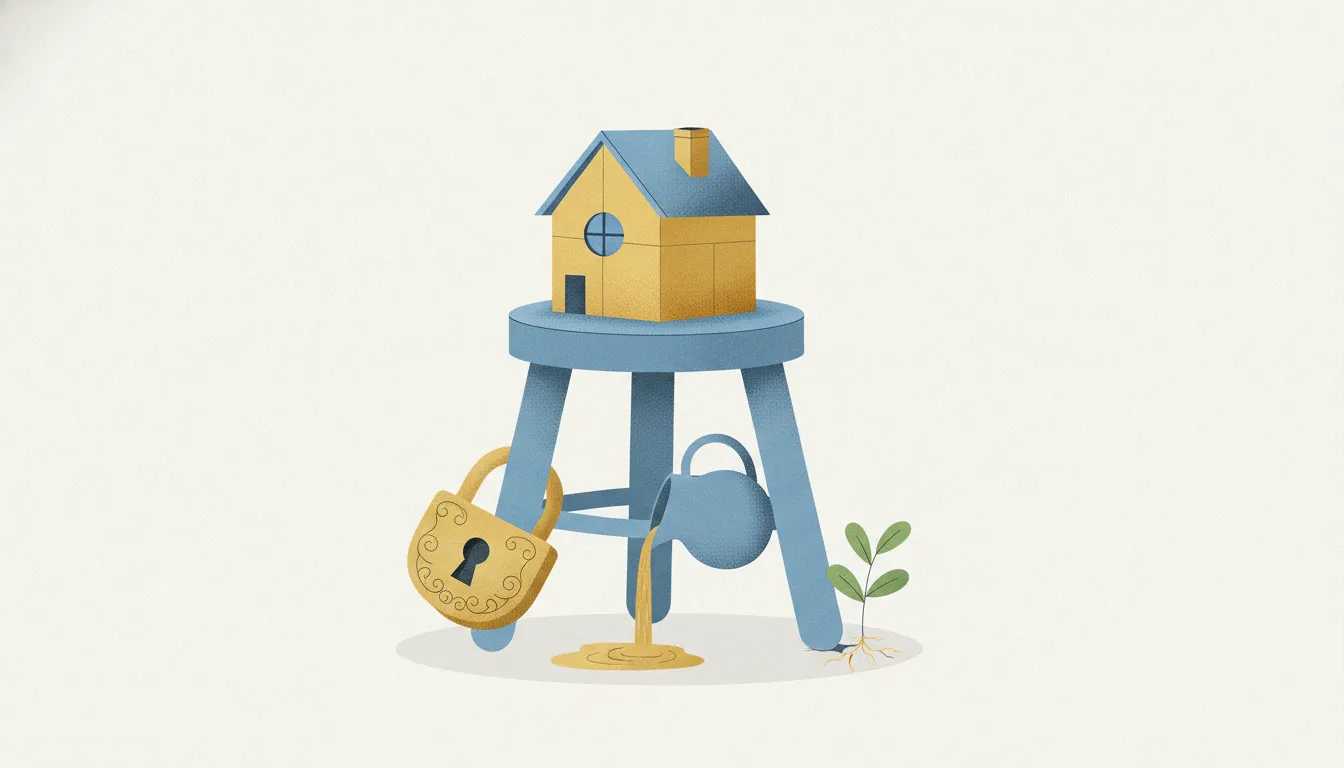
Most households track their money one account at a time. A mortgage statement here, a savings balance there, a home value estimate on a phone. Investors have long used three lenses to size up savings: safety, liquidity and return. This article asks a simple question: what do those same lenses show when pointed at a home and its mortgage? The short answer is that they do not hand out a verdict, but they do turn a vague worry into questions a household can actually answer.
Key takeaways
- Safety, liquidity and return are three lenses that investors use on savings, and they apply just as well to a home and its mortgage.
- A household can hold a lot of home equity and still have little cash it can reach quickly.
- A fixed-rate mortgage keeps the interest rate the same for the life of the loan, while an adjustable rate may go up or down.
- Paying down a mortgage and investing both give money a job, but they differ in certainty, risk and how easily the money comes back out.
- The lenses do not produce an answer on their own, they turn a vague worry into specific questions to ask.
Three lenses, borrowed from savings
The U.S. Securities and Exchange Commission's Investor.gov lists several things to weigh when choosing investments, including risk and return, fees, diversification and liquidity. Its summary of the trade-off is plain: all investments involve risk, and a greater potential for profit typically comes with a greater chance of losing money.
Those ideas travel well. A home is the largest asset many families hold, and a mortgage is often their largest debt. Looking at both through the same three lenses can show where a household is protected, where it is stretched and where its money is sitting idle.
Safety: what happens if things change?
Safety is about how well the setup holds up when income, rates or expenses move. The Consumer Financial Protection Bureau explains that with a fixed-rate mortgage the interest rate is set when the loan is made and will not change, while with an adjustable-rate mortgage the rate may go up or down. Taxes, insurance and repairs can change too, even when the loan payment does not.
Questions to ask:
- If my payment rose or my income dropped, how many months could we keep paying everything on time?
- Is the rate on my loan fixed, and if not, when can it change?
- What other housing costs could rise, and by how much?
- Does this setup add to my peace of mind or take away from it?
Liquidity: how quickly can I reach cash?
Equity is not cash. A household can own a home worth far more than it owes and still have only a small checking balance. Reaching equity generally means selling or borrowing against the home.
For example, picture a household with about $300,000 of equity and $2,000 in the bank. On paper it looks wealthy, yet a sudden bill of several thousand dollars could still land on a credit card.
The CFPB describes an emergency fund as a cash reserve set aside for unplanned expenses, and says it helps to keep that money safe and accessible. Borrowing is a different tool. The CFPB notes that a home equity line of credit usually has a variable rate, so payments may change from month to month, that falling behind could mean losing the home, and that a lender may restrict new borrowing if the home loses significant value or freeze it if the borrower's finances change. A line that exists on paper may not be available at the moment it is needed.
Questions to ask:
- How much cash could we reach within a few days?
- If we were counting on borrowing, could that door close at a bad time?
- How long would it take to turn the home's value into spendable money, and at what cost?
Return: what is each dollar doing?
Return asks what a dollar earns or saves in its current job. A dollar of home equity earns no interest by itself. A dollar sent to the mortgage avoids interest at the loan's rate. A dollar invested may earn more or less than that, or lose value.
For example, consider $10,000 applied to a mortgage with a 6 percent rate. That avoids roughly $600 of interest in the first year, a result that is known in advance. The same $10,000 invested could do better or worse, and by the Investor.gov summary above, any investment can lose some or all of its value. The example ignores taxes, fees and the shrinking interest savings as the balance falls.
Some households go further and ask whether borrowing against equity to invest makes sense. That adds a debt payment and market risk at the same time, which is why it deserves careful professional advice.
Questions to ask:
- What rate does my mortgage charge, and what could I earn or avoid elsewhere?
- How certain is each result, and how would I feel about a loss?
- Does moving money from one job to another leave me with less cash than I need?
Putting the lenses together
The lenses often pull against each other. Putting extra money into a mortgage can improve safety and produce a known result, but it lowers liquidity, since the money is hard to take back out. Holding more cash raises liquidity and may lower return. Neither direction is right for everyone.
A short worksheet can help: write one sentence for each lens about your own home, then list what you would change if the weakest lens could be strengthened without weakening the others. A licensed professional can help test those answers against your full picture.
Common questions
What do safety, liquidity and return mean for a household?
Safety is how well your finances hold up if rates, income or expenses change. Liquidity is how quickly you can turn assets into spendable cash. Return is what a dollar earns or saves for you in its current job.
Is home equity liquid?
Not by itself. Equity becomes cash only by selling the home or borrowing against it, and a home equity line of credit can carry a variable rate, put the home at risk and be limited or frozen by the lender.
Is paying down a mortgage a better use of money than investing?
There is no single answer. Paying down a mortgage reduces a known cost, while investing offers uncertain results and the possibility of loss, so households weigh their rate, their cash cushion and their comfort with risk.
Explore your next step
Sources and further reading
From the Borrow Smart newsletter
NIFE provides general financial education. LendsightAI and Debt Done Date are separate for-profit partners; optional services may have a fee.